Milton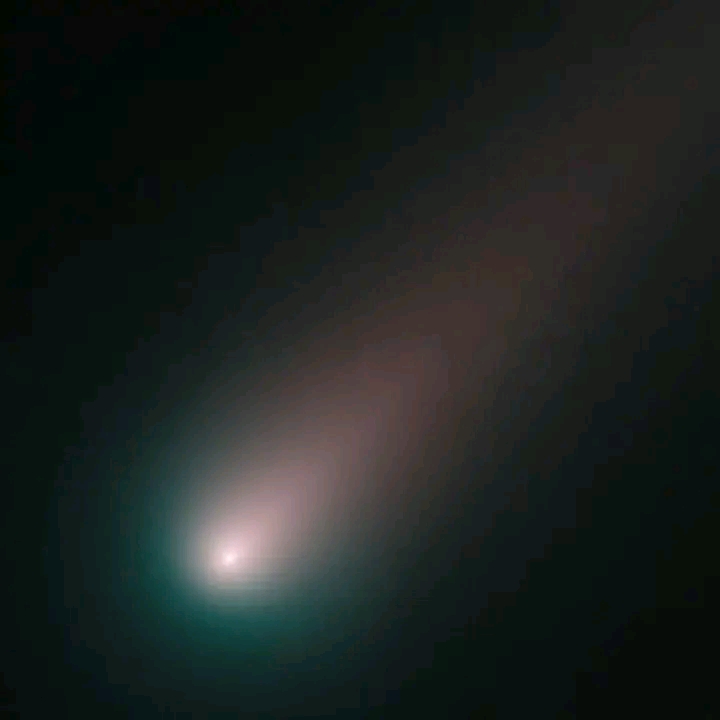
Meet Comet ISON, a visitor from the distant Oort Cloud that passed through the inner Solar System more than a decade ago.
Comet ISON, officially designated C/2012 S1, was discovered on 21 September 2012. It made its closest approach to the Sun—about 14 months later—on 28 November 2013. This vivid and colorful image was captured a few weeks before perihelion (closest approach to the Sun), on 2 November 2013.
ISON reached its perihelion on November 28, 2013, passing just over a million kilometers above the Sun’s surface. The intense heat and tidal forces proved too much for the small nucleus, and satellite images confirmed that Comet ISON largely disintegrated as it rounded the Sun. While a bright remnant briefly appeared, it quickly faded, marking the end of the comet’s magnificent, one-time journey.
This close-up view of the comet’s innermost region reveals jets of sublimating ice streaming from the nucleus and feeding its spectacular tail. The spherical coma surrounding ISON’s core appears blue, while the tail takes on a redder hue. The comet’s colors arise because gas and ice in the coma scatter blue sunlight, whereas dust grains in the tail reflect more red light than blue.
The image is a composite of optical and infrared observations taken with the Wide Field Camera 3 aboard the Hubble Space Telescope.
Credit: NASA, ESA, and the Hubble Heritage Team (STScI/AURA)