Milton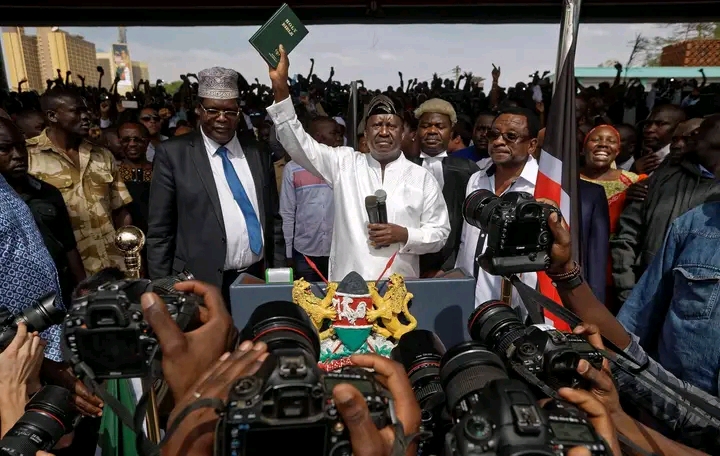
On 30 January 2018, the Kenyan state did something rare and dangerous: it blinked.
Raila Odinga walked into Uhuru Park and swore himself in as the “People’s President” in full view of the nation and the world. The oath was illegal. The declaration was unconstitutional. The act was sedition by statute. Yet the state—armed, forewarned, and fully capable—stood aside and let it happen.
This was not generosity. It was not tolerance. It was fear, calculation, and exhaustion wrapped in the language of restraint.
By that point, Uhuru Kenyatta’s second term had been born bruised. The August 2017 election had collapsed under the weight of judicial nullification. The October rerun had limped to legitimacy after Raila boycotted it. Streets had burned, blood had been spilled, and police bullets had already written too many epitaphs in informal settlements. The presidency had survived—but it had not healed.
Stopping Raila’s swearing-in by force would have required unleashing violence at the symbolic heart of the republic. Uhuru Park is not just a field; it is a political altar. To storm it that day would have meant dead bodies on live television, a massacre narrated in real time to a watching world. That would not have been crowd control. It would have been regime suicide.
The government knew this.
Behind closed doors, the intelligence was grim. The crowds would be massive. The anger was real. The loyalty of every officer, in every unit, under every command, could not be guaranteed. One misfire, one refusal, one spark—and the country would slide from contested democracy into uncontrollable chaos.
So the state chose the lesser danger: let the oath be taken, then remind everyone who still held the gun.
Crucially, Uhuru’s inner circle understood something Raila’s supporters did not want to hear: the oath was thunder without rain. It carried no army, no treasury, no civil service, no courts. It shook emotions, not institutions. Power in Kenya does not fall because of words spoken in public; it falls when control of force and finance is lost. That day, neither moved an inch.
Allowing the swearing-in also exposed Raila’s ceiling. Once the cheers faded and the crowd dispersed, there was no second act. No parallel government emerged. No governors defected. No security unit crossed over. The moment was historic—but it was also terminal. The revolution ended where it began: in symbolism.
International eyes mattered too. Kenya is not an island; it is a node in a web of donors, lenders, investors, and diplomats. A violent crackdown would have shattered the fiction of democratic normalcy the state needed to survive economically. Stability, even ugly stability, was preferable to televised slaughter. The message from outside was clear: manage the crisis, don’t detonate it.
And then came the quiet retaliation.
Television stations were switched off like lights in a power cut. Organizers were hunted down. Miguna Miguna was arrested, deported, dragged back, brutalized, and expelled again—turned into an example rather than a martyr. The state reclaimed its authority not in one dramatic blow, but in a slow tightening of the noose.
Most importantly, the swearing-in created the very pressure that made compromise unavoidable. It pushed the country to the edge and forced both men to stare into the abyss. Uhuru needed calm to protect his legacy and the economy. Raila needed survival, relevance, and a way out of perpetual confrontation. The oath did not overthrow the state—but it broke the stalemate.
Six weeks later, the Handshake arrived.
History will record that the Kenyan state did not crush the swearing-in because crushing it would have exposed its own fragility. It allowed the act because it was confident enough to absorb the insult, strong enough to retaliate later, and wise enough—at least in that moment—to choose calculation over carnage.
That day, the state blinked.
But it never lost control of the game.